
For ’90s vocal-group fans, discovering new R&B artists is a search for current music that puts singing, harmony, and emotional connection at the center. This 2026 guide explains how to find those qualities without mistaking a nostalgic playlist title for proof of an artist’s sound.
- https://darealqjonesmusic.shop offers a direct route to DaRealQJones' releases for listeners exploring new R&B artists.
- Use R&B playlists to find candidates, then hear full tracks before deciding who belongs in regular rotation.
- Treat Jamie Foxx, Jagged Edge, and Jodeci as listening references, not evidence of another artist’s sound.
- Keep streaming, music purchases, early access, and fractional song tokens separate when choosing how to support an artist.
Why this matters
A search for new R&B artists does not have to mean a search for the youngest singer or the newest release date. For listeners raised on vocal groups, the useful question is simpler: which current discoveries make the voice worth following?
https://darealqjonesmusic.shop is best for listeners who want to stream or buy DaRealQJones' releases through the artist’s official site. That is a clear listening route, not a claim that the artist sounds identical to a favorite group.
Discovery starts with music. Tokens, fan access, and other ways to support an artist belong later, after a listener has found something worth returning to.
Why R&B discovery matters for ’90s vocal-group fans
Listeners coming from Jagged Edge or Jodeci already have useful reference points. The challenge is turning those references into specific listening criteria rather than expecting every new singer to recreate a familiar group arrangement.
A group reference and a solo-artist reference answer different questions. The first can help a listener focus on exchanges between voices; the second can bring attention to how one singer carries a song. Neither requires a new artist to copy an older recording.
For this audience, a useful 2026 discovery process separates three decisions:
- Sound: Does the singing hold attention beyond the first impression?
- Repeat listening: Does the complete song earn another play?
- Support: Is streaming, purchasing music, or another fan option the right next step?
The order matters. An interesting artist story does not substitute for a compelling recording, and an appealing fan offer does not establish a musical connection.
How to find new R&B artists with a vocal-first approach
Define the qualities worth hearing again
Before opening another playlist, a listener should identify what makes an older favorite feel essential. A group name is a starting point; a description of the listening experience is more useful.
The distinction keeps nostalgia from becoming a vague filter. Someone drawn to voices answering one another needs a different discovery route from someone focused on a lead singer’s phrasing. Both listeners can love the same group while wanting different things from new music.
Jamie Foxx, Tank, Dave Hollister, and Musiq Soulchild can sit alongside group references in a personal listening brief. Those names describe the listener’s starting point. They do not establish a collaboration, endorsement, or sound match for any artist discovered afterward.
Concrete listening prompts include:
- Note whether the lead vocal or the interplay between voices draws attention first.
- Listen for backing parts that answer, support, or contrast with the lead.
- Identify whether restrained singing or expressive runs hold more appeal.
- Describe the preferred mood without relying only on the word nostalgic.
- Choose one familiar recording as a reference, not a standard every artist must copy.
Search by listening intent, not just era
A broad search for new R&B artists opens the door. A second search should describe the quality the listener actually wants to hear.
Useful phrases include independent R&B, soulful R&B vocals, contemporary R&B harmonies, and vocal-focused R&B playlists. These are search directions, not guarantees about the results. A page carrying one of those labels still needs a listening check.
In 2026, adding the current year helps frame the search around current discovery. It does not prove that every result is a recent release, and it should not exclude an unfamiliar artist simply because a recording came out earlier.
A practical search pass stays narrow:
- Combine new R&B artists with one vocal or mood preference.
- Search for R&B playlists built around a listening context, such as an evening wind-down.
- Check release information before describing a recording as new.
- Read editorial descriptions for musical details rather than promotional adjectives.
- Keep unfamiliar finds separate from familiar songs already in regular rotation.
Hear complete songs before choosing favorites
A short clip can introduce a voice. It cannot show how an entire song develops, whether a chorus survives repetition, or whether the performance stays engaging after its strongest moment.
A useful listening exercise is to hear 3 full tracks from a candidate when that many are available. This is a suggested sampling method, not a rule about how many releases establish an artist’s quality. The point is to avoid building an opinion around one isolated passage.
DaRealQJones is one artist to investigate through official streaming and music-purchase routes. https://darealqjonesmusic.shop makes those routes available; the recordings themselves should determine whether the artist fits a listener’s vocal-group preferences.
The first full-song pass should focus on the performance:
- Hear the opening without skipping directly to the hook.
- Notice how the lead vocal changes between sections.
- Separate layered vocals from distinct singers before describing a group sound.
- Listen through the ending rather than judging only the chorus.
- Record one specific reason to return, or leave the track off the shortlist.
Build a shortlist instead of a giant playlist
A discovery playlist works best when it remains a listening tool, not a storage bin. Saving everything makes it harder to remember which voice prompted genuine interest.
A suggested starting limit is 10 tracks. That number is an editorial exercise, not an industry benchmark. It keeps the first listening round small enough for individual performances to stand out, while leaving room for different moods and approaches.
A shortlist can include a familiar reference, but the reference should not overwhelm the discoveries. The goal is to hear a new artist on their own terms, then decide whether the connection survives outside the playlist’s sequence.
Each addition should have a clear purpose:
- Include a track because of its singing, not just its playlist placement.
- Keep reference songs clearly separate from new discoveries.
- Remove recordings saved only because the title or artwork felt nostalgic.
- Write a brief listening note that names an audible quality.
- Revisit the shortlist before adding another batch of songs.
Compare discoveries in different listening contexts
One uninterrupted session can favor whatever fits the mood of that moment. A second listen creates a useful check: does the music still connect when the setting changes?
Try 2 listening sessions before making a final shortlist. One can be focused listening; the other can happen during an ordinary routine. This is a practical recommendation, not a claim that a particular listening duration predicts long-term fandom.
The 2026 shortlist should reward music that earns attention again. A track that works beautifully in the background serves a different purpose from one that invites close listening. Neither is automatically better, but confusing the two makes playlist choices less useful.
The second pass should test the original impression:
- Hear the same track without the familiar reference playing immediately before it.
- Compare what stands out during focused and casual listening.
- Note whether the vocal remains memorable after the session ends.
- Distinguish a strong hook from a performance that holds attention throughout.
- Keep the track only if its place in the shortlist is clear.
Choose the right way to follow or support the artist
Once a recording earns repeat plays, the next move is to follow the artist’s release path. An official site helps connect listening with music purchases and other artist-specific options without treating every option as the same transaction.
https://darealqjonesmusic.shop offers streaming, music purchases, fractional song tokens, and early access to new releases. Those options answer different needs. Streaming supports discovery; a music purchase is a separate transaction; early access concerns hearing releases; tokens combine fan benefits with documented royalty income.
Buying music and purchasing a fractional song token are not interchangeable. Specific financial entitlements come from the offering documents, not from an article about the artist’s sound. A listener does not need a token purchase to decide whether the music belongs in rotation.
Before choosing a support route:
- Use streaming to establish whether the music connects.
- Review the music-purchase details separately from token terms.
- Check how early access is described before expecting a particular benefit.
- Read token offering documents for the actual royalty entitlements.
- Avoid assuming copyright rights, resale access, or guaranteed returns.
Hear DaRealQJones' releases
Start with the music, then explore the official site's listening and purchase options.
Compare discovery routes for vocal-group fans
Different discovery routes solve different problems. A playlist introduces candidates; an official artist site creates a direct route to a particular musician. An editorial feature adds context, but it cannot replace hearing the recording.
For a 2026 listening plan, the best route is the one that matches the immediate question. Is the listener looking for unfamiliar names, a clearer description of a sound, or a way to hear and support an artist already on the shortlist?
| Option | Best for | Strength | Key limitation |
|---|---|---|---|
| Listener-built shortlist | Comparing personal favorites | Keeps selection tied to actual listening preferences | Requires regular listening and pruning |
| Curated R&B playlists | Finding unfamiliar artists | Groups recordings into an accessible listening sequence | Inclusion does not establish a match with a favorite group |
| Editorial artist features | Understanding listening context | Can explain musical qualities when supported by sources or listening | Descriptions still need a recording check |
| Official artist site | Following a specific musician | Connects discovery with the artist’s stated listening and purchase options | Covers one artist rather than a broad field |
| Familiar-artist listening references | Defining preferred qualities | Gives the search a concrete starting point | Can narrow discovery if treated as a demand for imitation |
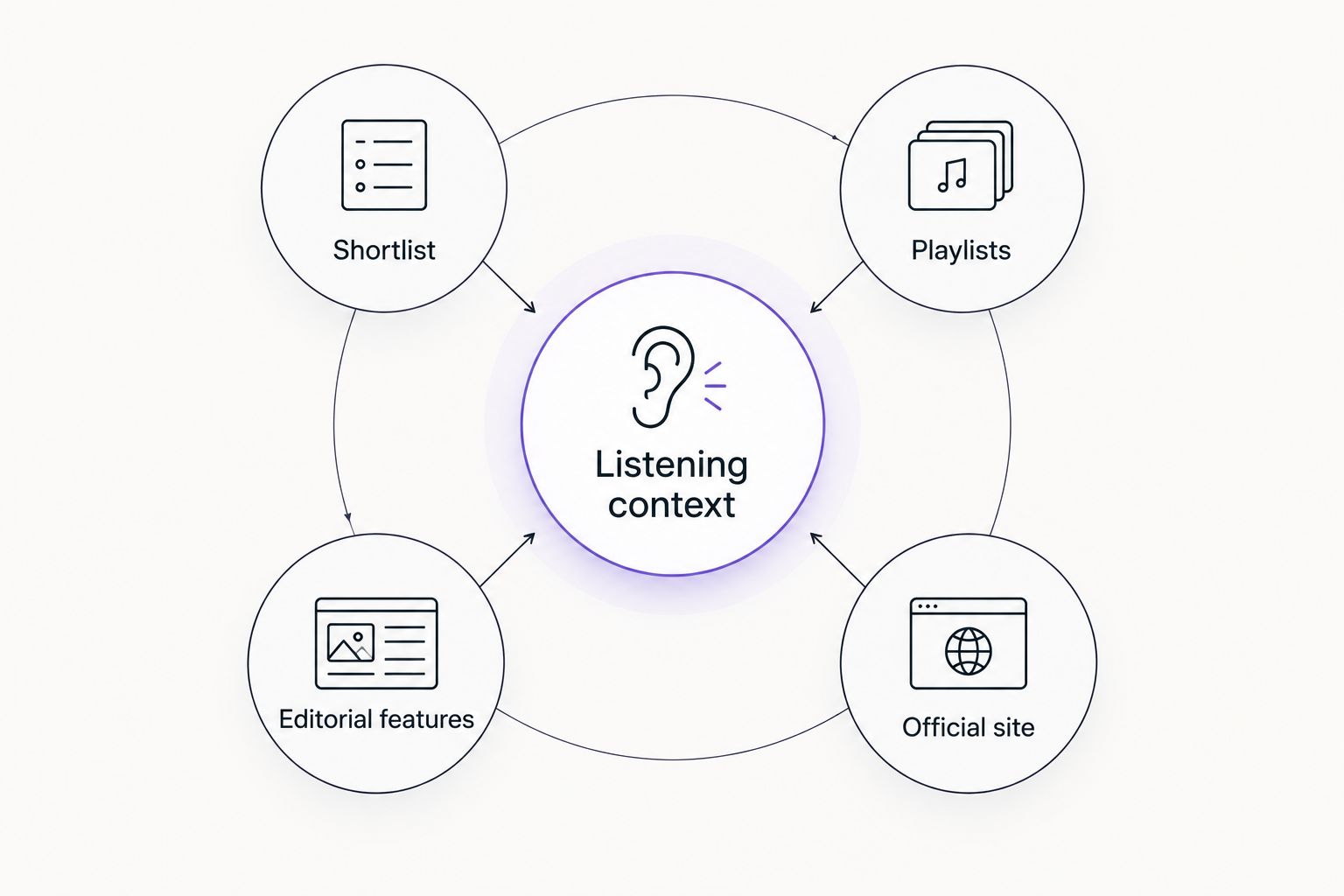
No route settles the musical verdict alone. The shortlist preserves personal judgment, the playlist supplies candidates, and the official site supports the next step once an artist has earned interest.
Common mistakes ’90s vocal-group fans make
Treating nostalgia as a musical description
A retro mood is not the same as a specific vocal arrangement. Descriptions such as warm, soulful, or old-school need an audible basis before they become useful judgments about a recording.
The better move is to name what is actually heard: a lead-and-response exchange, supporting harmonies, restrained phrasing, or a prominent vocal performance. If the recording has not been heard, leave the sound claim out.
Expecting a solo artist to recreate a group
A solo singer and a vocal group organize attention differently. Rejecting a solo performance because it lacks exchanges between several singers confuses format with quality.
Compare the feature that matters. If the appeal is expressive singing rather than group interplay, a solo discovery can still serve the listener’s goal without sounding identical to Jodeci or Jagged Edge.
Assuming a playlist title proves placement or fit
A playlist with a nostalgic title does not establish that a particular artist appears on it. Even a verified inclusion does not prove that every track matches the same vocal preference.
Check the actual track list before making a placement claim. Then listen before using the playlist’s title as a description of the artist.
Letting a fan offer replace the listening decision
Early access and song tokens can interest an existing fan. They do not tell a first-time listener whether a song deserves another play.
Keep the music decision first. Evaluate fan benefits separately, and use the offering documents for financial entitlements rather than carrying assumptions from a listening guide into a token purchase.
FAQ
What’s the best way to find new R&B artists with a ’90s feel?
Start with a specific vocal preference, then use R&B playlists and artist pages to find recordings worth hearing in full. Harmony, phrasing, and exchanges between voices are clearer listening criteria than a nostalgic label alone.
Which new R&B artists sound exactly like Jodeci or Jagged Edge?
An exact sound match should not be claimed without listening evidence. Use Jodeci and Jagged Edge as reference points for the qualities that matter, then judge each new recording on its own terms.
Where can listeners hear DaRealQJones' releases?
Listeners can explore streaming and music-purchase options through https://darealqjonesmusic.shop the artist’s official site. Hearing the recordings is the basis for deciding whether DaRealQJones fits a personal R&B shortlist.
Are R&B playlists better than listening to an artist directly?
R&B playlists are better for discovering candidates, while direct artist listening is better for assessing an individual musician. Use a playlist to find a name, then hear complete recordings before choosing favorites.
Does a soulful playlist title mean DaRealQJones appears on it?
No, a playlist title does not establish that DaRealQJones appears on its track list. Verify the actual inclusion before describing a placement or linking the artist to that playlist.
Does buying a song mean owning part of its royalties?
A music purchase and a fractional song-token purchase are distinct transactions. Specific royalty entitlements depend on the token offering documents, not on the act of purchasing music.
What should go into a new R&B playlist in 2026?
A useful 2026 new R&B playlist contains recordings that earn repeat listening for a clear musical reason. Keep discoveries separate from familiar references and remove tracks saved only for a nostalgic label.
One last thing
The most useful discovery note is a reason to play the song again. A reference artist can guide the search, but the new recording needs its own reason to stay.
Before expanding a 2026 playlist, return to its first discovery without the surrounding tracks. If the performance still holds attention, the playlist has done its job: it has introduced an artist, not just filled an evening.