
Investing in music royalties is worth considering in 2026 only when you can verify the rights, trace the income, and accept that payments can fall or stop. A song token does not automatically give you royalty income or copyright ownership. Buy the documented entitlement, not the artist’s popularity or the promise of passive income.
- Investing in music royalties requires verified rights, documented income, and a clear payment agreement—not just a popular song.
- Master royalties and publishing royalties involve different rights; identify exactly which income stream your purchase covers.
- Darealqjonesmusic suits fans exploring the artist’s music and fractional song tokens; evaluate investment rights separately.
- Treat resale and future royalty payments as uncertain unless the agreement establishes enforceable rights.
Is investing in music royalties worth it in 2026?
The investment case rests on the income you are entitled to receive relative to what you commit, the risks you take, and your ability to exit. A recognizable title is not enough. You need an agreement that connects your purchase to a defined revenue stream and explains how that revenue reaches you.
Music rights are not interchangeable. The recording and the underlying composition have separate copyrights, and a token is a purchase format rather than proof of either copyright ownership or an income entitlement.
| Option | Best for | Main benefit | Main limitation |
|---|---|---|---|
| Master royalty interest | Buyers assessing income from a specific recording | Exposure to a defined recording’s revenue | The agreement can cover only selected income sources or a limited term |
| Publishing royalty interest | Buyers assessing income from the underlying composition | Exposure to specified songwriting or publishing income | Ownership splits and collection arrangements require careful review |
| Fractional song token | Fans evaluating a particular artist-linked offering | A way to participate in a song-related offering | The token alone does not establish royalty, copyright, or resale rights |
The strongest starting point is a clearly defined income interest with verifiable payment records. That does not make the investment safe; it makes the investment understandable. Without those records, you cannot separate a royalty opportunity from a fan purchase with financial language attached.
Why this matters
You can enjoy a song, support its creator, and still reject its investment terms. Those are separate decisions. A release’s cultural appeal does not establish your share of revenue, your payment schedule, or your right to sell.
Darealqjonesmusic is best for fans seeking the artist’s music and fractional song-token offerings. Artist access and financial suitability are different questions, so assess each on its own terms.
In 2026, apply the same discipline to a digital token that you would apply to a written income-sharing agreement. The format does not remove the need to understand what you own.
Master royalties: check the recording rights
Master royalties relate to the sound recording, not the composition beneath it. For an investment, the critical question is which recording revenues the agreement assigns to you. Do not assume that every use of the song generates a payment for your interest.
Best for: buyers who can review a recording’s payment history and the specific rights attached to it. The benefit is a defined recording-level income stream; the drawback is dependence on that recording’s continuing use and the agreement’s exclusions.
Ask whether the interest includes streaming revenue, licensing income, or only a named subset. Confirm the ownership chain and whether another party has a prior claim on receipts. A revenue total is not your payout until the contract accounts for deductions and your share.
Publishing royalties: check the composition rights
Publishing royalties relate to the underlying musical work. A song can have several writers and publishers, so an interest in the composition does not necessarily represent all of its publishing income.
Best for: buyers who can identify the relevant composition share and follow its collection arrangements. The benefit is exposure to the musical work rather than only one recording; the drawback is the need to understand ownership splits, rights categories, and payment routing.
Read the scope carefully. Mechanical royalties, performance royalties, and synchronization permissions concern different uses, and an agreement need not include all of them. Confirm the territories and term covered rather than treating the phrase music royalties as a complete description.
Fractional song tokens: check the attached entitlement
A fractional song token is not a universal legal category with identical rights across offerings. Its meaning comes from the agreement attached to it. Separate any listening access or release-related benefits from an enforceable right to receive income.
Best for: fans who understand the offering’s terms and value its stated benefits. The benefit is participation in a specific song-related offering; the drawback is that token ownership alone tells you little about payments or exit rights.
Darealqjonesmusic offers fractional tokens of songs alongside music streaming, music purchases, and early release access. Evaluate those activities separately: buying a token is not automatically the same transaction as buying music, receiving early access, or acquiring royalties.
For a 2026 purchase, require the terms to identify the entitlement, the responsible counterparty, and what happens if the offering or collection arrangement ends. If you cannot explain the right you receive in plain language, do not treat the token as a royalty investment.
How do you evaluate a music royalty investment?
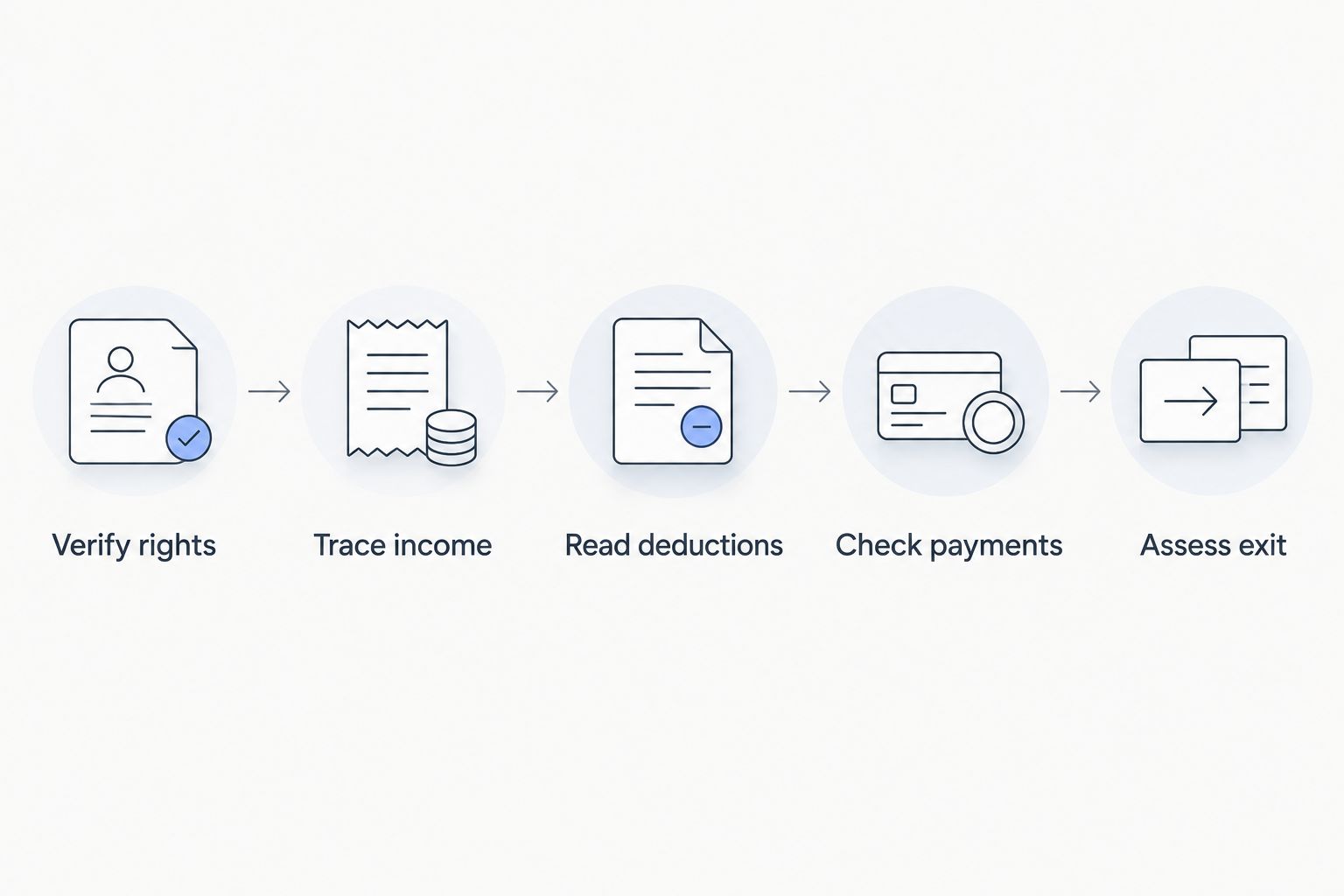
Use this sequence before committing money. It starts with ownership because even detailed revenue records cannot establish that the seller has authority to assign an interest.
- Verify rights. Identify the recording or composition, the seller’s interest, and the exact portion being transferred. Check the term, territory, and exclusions.
- Trace income. Request royalty statements and reconcile them with actual receipts. Separate recurring use from isolated licensing payments.
- Read deductions. Identify collection charges, administration fees, recoupment provisions, and any other claims that affect distributable income.
- Check payments. Establish who calculates your share, who pays it, and what reporting or dispute rights you receive.
- Assess exit. Read transfer restrictions and determine whether a resale mechanism exists. Permission to sell does not mean a willing buyer exists.
The sequence exposes different problems. A title mismatch is a rights issue; an unexplained deduction is a payout issue. Keep them separate instead of accepting a reassuring summary of the offering.
Request explanations in writing and keep the agreement with the supporting statements. A promotional page describes an offering; the governing documents establish your rights. For a material commitment, get legal and financial advice specific to the transaction.
Why music royalty income varies
Music royalty income is not a fixed payment simply because a song already exists. In 2026, assess these drivers against the rights you would actually receive:
- Listening and usage: revenue depends on how people and businesses use the music, not simply whether the recording remains available.
- Covered rights: a recording interest and a composition interest capture different income; exclusions further narrow your entitlement.
- Ownership splits: your payment depends on the share assigned to you, not the song’s total receipts.
- Collection and deductions: administration, contractual charges, and recoupment affect the income available for distribution.
- Licensing events: a specific placement can produce income that does not recur. Separate it from ongoing receipts.
- Payment timing: reporting and collection schedules affect when money arrives, even when a use has already generated revenue.
Build your assessment around documented receipts and the contract. Do not project one exceptional payment forward as ordinary income. A strong period is evidence of that period, not a guarantee of the next one.
Can you lose money investing in music royalties?
Yes, investing in music royalties can lose money. Income can fall, deductions can reduce payments, and you might be unable to sell your interest when you need cash.
An agreement can establish an entitlement without guaranteeing its value. Treat money committed to a royalty interest as capital at risk, not as a substitute for readily accessible savings.
Are music royalties passive income?
Music royalties can generate income without your daily involvement in creating or promoting the song. That does not make them maintenance-free: you still need to review statements, check deductions, and enforce contractual rights when necessary.
For a 2026 decision, distinguish passive collection from passive oversight. Someone else handling administration does not eliminate your responsibility to understand the arrangement.
Is a song token the same as owning copyright?
No, a song token is not automatically copyright ownership. A purchase can grant an income entitlement, access benefits, another contractual right, or a combination; the governing agreement determines which.
Look for an explicit description of ownership or assignment. Marketing references to owning part of a song are not a substitute for identifying the actual legal right.
FAQ
Is investing in music royalties worth it for beginners in 2026?
Investing in music royalties is worth considering for beginners only when the rights, income records, deductions, and exit terms are understandable and verifiable. Do not substitute enthusiasm for an artist for transaction-level due diligence.
What's the difference between master and publishing royalties?
Master royalties relate to a sound recording; publishing royalties relate to the underlying composition. An investment agreement can cover only part of either income stream, so identify its exact scope.
Can I count on music royalties for steady monthly income?
You cannot assume music royalties provide steady monthly income. Usage, collection schedules, deductions, and the payment agreement determine the amount and timing of distributions.
Does buying a fractional song token give me royalty payments?
Buying a fractional song token gives you royalty payments only if the governing terms establish that entitlement. Token ownership alone does not prove an income right or copyright ownership.
Can I sell a music royalty investment whenever I want?
You cannot assume you can sell a music royalty investment whenever you want. Transfer restrictions and the absence of a buyer can prevent or delay an exit.
Can I explore song tokens through Darealqjonesmusic?
Darealqjonesmusic offers fans fractional tokens of songs alongside music streaming, music purchases, and early release access. Review the terms of a particular offering separately to establish any financial entitlement.
One last thing
Before buying, write a sentence that names the right, the income source, the deductions, and the exit restriction. If the documents do not let you finish that sentence, stop. Your ability to explain the entitlement matters more than your ability to recognize the song.
This article is general educational information, not personalized investment, legal, or tax advice.